Civic Resolves for the New Year

Happy New Year! Welcome back to whatever this is. I have received a number1 of emails and texts asking when I’d be back.
While Auld Lang Syne2 still rings in our ears, the time is ripe to adopt some civic resolves for this new year, which will surely be one to remember.
Resolves
Why “resolves” and not “resolutions”? Well first, it sounds fancier. Part of my shtick here is framing civics in our time through the lens of the Founding era, in hopes of both 1) making the principles of the American Founding more tangible to a historically checked-out generation, and 2) compelling some of the relative idealism and civility of that age into our own. So I’m going to pick the fancier, more powdered wig/hear ye hear ye word whenever I get the chance.
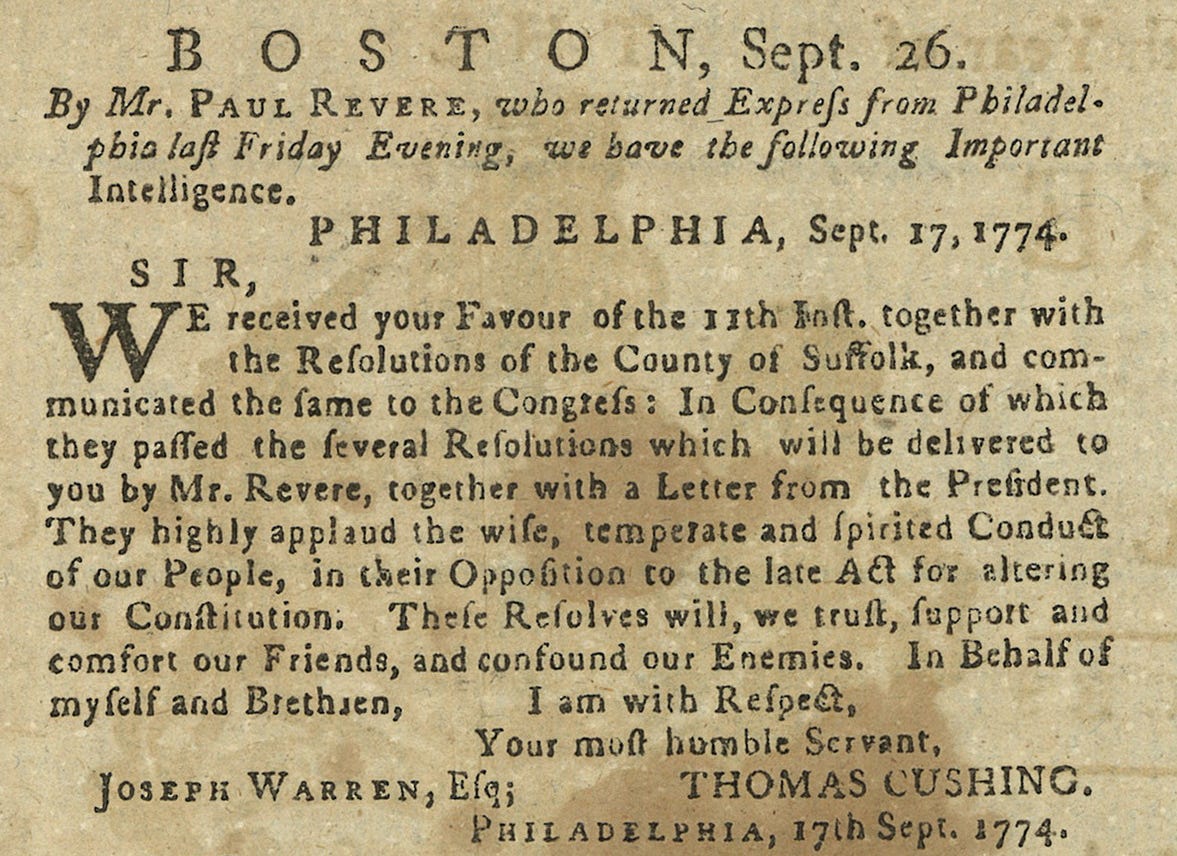
Second, and not that I need another reason since this is my blog, but resolves as a concept is also a more precise description of how we ought to frame civic engagement, and furthermore is in line with how Americans from the dawn of our nation would have as well. To them, a resolve was a serious, considered statement of substance and action. A simultaneous assessment of a circumstance against core principles paired with a tangible response. Take for example the Suffolk Resolves or the Virginia Resolves.3 These were statements made by the people, often through their representatives, asserting their views on critical topics of the day and what they were going to do in response. In that vein, I offer today some civic resolves for an important civic age.
A Banner Year
Quick detour - civic engagement matters every single day in our representative government. In fact, everyday civics is the only real kind. Still, there are moments in time where civics is more visible, and I think we’re entering such a time. In fact I think this year will be the most significant in our lifetimes for reflecting on our civics and resolving to improving them.
In case you haven’t heard or noticed, this is our nation’s 250th anniversary - 250 years since the Declaration of Independence. Our nation has lived a million lives since then, but through them all our founding principles of liberty, equality, and self-government have endured. I believe they will much longer. And this requires each of us entrusted with citizenship in this Republic to understand, hold dear, and advance those principles. Resolving to do some of the basics can help re-energize this effort.
Whereas
Any resolve worth its salt starts by laying out the issues or topics serving as a precursor to the need to make resolves. Here’s mine:
As our nation turns 250, we are experiencing a confluence of challenges to our civic well-being:
Record low levels of participation in the political process;
Record low levels of trust and credibility of civic institutions;
Record low levels of basic civic understanding; and
Record high distractions to civic life.
The fundamental unit of action in self-government is the individual, choosing to understand and act as he or she can.
We cannot solve “we” until each of us acts as “I”.
Now, Therefore
To that end, I make the following civic resolves for our nation’s 250th year, and I invite you to do the same:
Recognizing that my action as a citizen is necessary to my own self-government, and further recognizing that my ability to express my views with impact is a privilege hard won and sustained, I resolve to vote in any election for which I am eligible to do so this year.4
Recognizing that productive citizenry requires understanding of the means and mechanics of self-government, I resolve to learn more this year about how my state, local, and federal governments actually work.
Recognizing that a productive opinion is an informed opinion, I resolve to create a focused personal method of learning about the issues affecting my community, with a preference for credible, primary news sources and a resistance to hyper-partisan or purely commentary sources.5
Recognizing that the American Experiment was founded on and endures on the basis of core principles, including but not limited to liberty, equality, and self-government, I resolve to refresh my understanding of these principles through primary sources and to reflect on their enduring significance and how I can promote them in my spheres.
Recognizing that self-government was formed on and can only survive on these principles, I resolve to analyze issues through lenses of these principles and not raw emotion or tribalism.6
Recognizing that politics is merely one lens of the civil society to which I belong, and that voluntary association is a vital part of civil society, I resolve to embrace opportunities for service and civic association in my community.7
Recognizing that civil society is the culmination and reflection of principles reflected in all spheres of life, I resolve to serve first and foremost in my home and my neighborhood.
And, recognizing that the ability to self-govern and live in freedom is a privilege and a historical anomaly, I resolve to give thanks for this privilege.
This civic year is going to be huge. A full-year of reflecting on 250 years of the American Experiment stands to be the singular civic moment of this age. I hope you’ll join me in raising the standard for your own civic engagement this year. We will all be better for it, as we together continue the good work of forming a more perfect union.
Zero is a number.
Sadly for the Scots, since the emergence of Mr. Jefferson’s University Auld Lang Syne is merely the second best song sung to that tune - The Good Old Song.
There are many, many examples like these. Before organized or social media, statements like these were means of both gathering and asserting popular opinion. They also took effort to organize and print, rendering a seriousness to the exercise. Groups of people in many places published resolves like this in the Revolutionary era, mostly on the topic of British rule but also on any number of other important topics of the day.
Ballotpedia, your one-stop shop for election information here, there, and everywhere.
Why “focused”? Because good health and good living require being in that middle ground between knowing nothing and consuming everything. Ignorance breeds misunderstanding and fear, and hyper-vigilance does the same. More does not equal better. And note that I resolve to focus on issues primarily “affecting my community.” If I, as some dude in Alabama, know more about political fights in Europe or the latest social snippet from a Senator from NY than I do about what my city council is doing, then I’m focusing in the wrong place.
This is hard. We love to graft our principles onto political figures and then assume that whatever those figures do, it squares with our principles. That’s the easy way, but dangerous. Such an approach only breeds partisanship. We must commit to knowing what we stand for, and assessing what’s happening around us through that lens.
As an extreme example, did you know that Washington, Jefferson, and Madison were estranged from each other in the post-Revolutionary period through basically the end of their lives? It’s complicated, but this is mainly because Washington thought that suppressing civic associations that were, in his mind, fomenting dissent in the new states was an appropriate safeguard against dangerous unrest. Jefferson and Madison felt that suppressing these groups was a form of tyranny. These are legends of principle we’re talking about, and they were bitterly divided. Depending on your view, one or more of them was badly wrong. All that to say, don’t marry your principles to any one person or group in civics. It is the principles that endure, not the people. Not even Washington, Jefferson, and Madison!
There is no town too small or city too large for this - Rotary, soup kitchen, nonprofit service, refereeing youth sports, you name it.
More footnotes