Faction - A Feature, Not A Bug

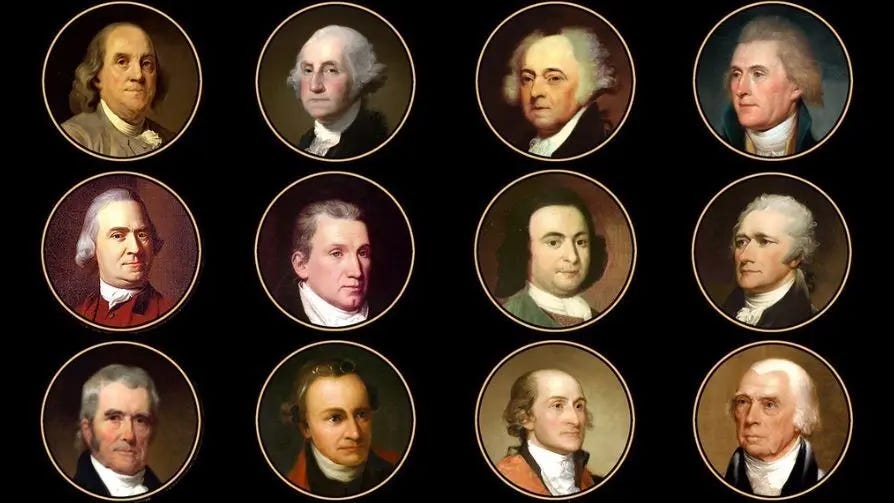
The signs of faction are everywhere - competing media, polarization on every conceivable issue, dueling yard signs in every election cycle, massive protests. Not to mention the incomprehensible shouting in public discourse.1 Has it always been this way, or is this a new age of polarization? Can we eliminate faction? Should we? Do aspiring authors just ask rhetorical questions in a vain attempt to sound sophisticated?
I consider these questions in today’s post, which is a slightly re-worked version of a piece I published in 2023. You already know that my motivation for reposts is padding my stats - see Shameless Repost #1. Still, the topic of faction is always relevant. You’ll learn below that I think we’re in trouble the day there is no faction. In fact, I adopt wisdom from the Founders in believing that (most) faction is a predictable and productive feature of representative government for a free people.
Better Thoughts Than Mine
Before we get to the article, there are a handful of resources I want to recommend. Each are far superior to anything I’ll write, but they lack the [note to self - make up something good about your own work and put it here before publishing] of my analysis.
First, I implore you to read this classic Harper’s essay on the ever-presence of anger and polarization in the American political machine. The author masterfully illustrates how a “paranoid style” has been part of the American civic discourse since the beginning, and it is this paranoid style that breeds anger and polarization and sometimes causes us to retract from pluralistic ideals. Basically, we have a tendency to believe that the “other” or the unknown in politics is out to fundamentally destroy us, and we behave accordingly. That’s not new. Now, is that sometimes true? Of course! There are people out there whose beliefs are fundamentally incompatible with my own, and that’s true for every person at every point on the political spectrum. It is when we believe that every difference is irreconcilable that it turns unproductive and even violent.
Second, I cannot recommend in strong enough terms that you read The Soul of America: The Battle for Our Better Angels by Jon Meacham. Yes, I am a Meachamaniac, it’s true. But it’s only because he consistently produces some of the most comprehensive, honest, yet patriotic analyses of our nation’s most important people and times.2 It doesn’t hurt that he’s from Chattanooga, TN, just down the road and easily the second finest town in the Tennessee Valley.
Third, for a more academic and far-reaching work on fear as a motivator of political discord, check out Alan Kahan’s Freedom From Fear: An Incomplete History of Liberalism. If Meacham’s book is an episode of your favorite NBC procedural crime drama, Kahan’s book is a grainy video of a four-hour lecture on criminal procedure. It’s dry, folks. But it is an amazing survey of how classically liberal orders developed in response to fears of their times, and careful attention to its conclusions (with which I don’t universally agree) can help us understand how our classically liberal American society responds to the fears of our day. And it can help us avoid fear-based civic engagement.
Fourth, a grab bag of goodies:
An excellent call from the Bush Center for what it calls “courageous pluralism.”
Disagree Better, an effort from a bipartisan coalition of governors to inspire Americans back to more civil disagreement.
Every single shot of Rory McIlroy’s thrilling victory in the 2025 Masters. A performance that transcended party or country.
My Thoughts, Lesser Than Those Above
Without further ado, here is the mostly-unchanged piece I published in 2023. I stepped out and published this with little forethought, in response to a tidal wave of conversations in my personal life where friends were expressing how divided we were, how unprecedented that was, how dangerous the division was, and how the Founders never would have imagined such. Not so, said I!
Unfortunately the negative trends identified in here remain true, and I think the stats around engagement and polarization are probably even less favorable. But the remedies and enduring principles are just as true as well! And that’s what counts.
Faction and the Founders: Wisdom for Our Times
At some recent moment before opening this, you were surely confronted with the bitter divisiveness that defines our political era. Whether it’s the big ticket items in the news - e.g., ongoing and potentially record government shutdown - or needless partisan squabbles on every Nextdoor comment section, the hyper-partisanship that characterizes daily life for our body politic feels inescapable.
No matter what your politics, you likely fall within the nearly two-thirds of Americans who are “exhausted” about politics, or the 63% with “not too much confidence” or “no confidence at all” in the functioning of our political system. And it seems like it’s getting worse! How can we as ordinary citizens move forward in times like these?
There is good news and a call to action on this subject found in the wisdom of the Founders.
The Cause and Purpose of Faction
The divisiveness we are currently experiencing is only a magnified form of what the Founders called “faction.” Faction is more than just disagreement, faction is the idea that people will inevitably use their voices pursuing differing goals in a representative government. They will do so with varying degrees of passion and conflict will always result. It will get messy. But the ability of a people to express faction is evidence of a free society, and the process of exchanging ideas in faction shapes society. The messiness is the point.
In “Federalist No. 10,” James Madison makes the case that faction is inescapable but not inherently ruinous. He asserts that faction will always arise in representative governments because governments are comprised of humans, and humans are self-interested. Because our self-interests do not all align, humans invariably come to conflict on the political means to achieve our goals.
Madison asserted that such faction is not only expected, but vital to and symptomatic of a functioning representative government. He timelessly reasoned that the only ways to remove faction are to remove liberty (unthinkable) or to remove differences of opinion (Orwellian). To Madison, the existence of faction means that the government at least functions well enough to advance the differing aims of its populace.
Was Madison naïve, operating in an environment of simplistic unity?
Hardly! Faction was real and at fever pitch in Madison’s time. The new Constitution and the role of federal versus state powers were heated public debates, not to mention still-smoldering divisions from the Revolution.3 Among other complaints, the political public of Madison’s time felt that their “governments [were] too unstable,” and that the “public good [was] disregarded in the conflicts of rival parties.”
Sound familiar? The only difference between the Founders’ era and ours in this regard is that we suffer from the accelerating effects of social media and a 24-hour global news apparatus.
What To Do About It
In short, faction’s existence is evidence that each of us still has a representative voice. And therein lies the call to action – use it wisely.
How can we do this? First, each of us have a responsibility to be civically and politically informed. Many of the Founders held this as a pillar of representative government. Thomas Jefferson held deep conviction of this principle, famously writing, “whenever the people are well-informed, they can be trusted with their own government.”
In this age of misinformation and misdirection, this task is harder, yet more critical than ever. We must educate ourselves on the processes, policies, and people that shape our lives, from the homeowner association to the White House. Practically, this means diversifying our news sources, consulting primary documents, taking an interest in the how and what of civics, and even reading viewpoints with which we disagree! Ignorance is not good enough for the American citizen if we hope to preserve our liberties.
Once informed, we must hold our elected officials and candidates to a higher standard than simply opposing those we oppose. Even back in 1787, Madison warned of candidates who would primarily operate through political arts and not with experienced, constructive leadership. In his guidance on faction, Madison implored the people to lift up leaders of “the most attractive merit.” Where faction is heightened, as it is today, the temptation is strong to support those who are most vocally opposed to our own political enemies. Yet if we do so without asking whether they are capable of enacting the government we seek, then we forfeit our political goals at the start.
Third, we must stay engaged. A record number of Americans are not participating in the political process at all. Participation in civic life occurs on an enormous spectrum, but voting is the starting line. The rest can take many forms, from local advocacy to communicating with your representatives to editorializing.
I make no prescription about the right answer for each citizen; the point is just to be engaged. We have the privilege and responsibility to do so as citizens in a representative government to which the rest of the world aspires. Perhaps Jefferson put it best in saying, “government is the strongest of which every man feels himself a part.”
And what if we don’t? What if in this era of seemingly unchecked faction, the two-thirds of the American public who are exhausted just give up entirely?
The stakes are high and the consequences clear. When the “silent majority” stays truly silent by not voting, not running, and not advocating, the passionate extremes are increasingly overrepresented. And when that occurs, those who turn the gears of government do not actually represent the populace at all.4
Moreover, when the political process decouples from the people it exists to represent, the system of representation itself is at risk of degradation. You don’t need me to tell you about the ills of authoritarian governments; simply check world headlines.
Hope
This American experiment is still an infant on a global geopolitical basis. Yet in our short existence, we have repeatedly been the standard-bearer for the advancement of human liberty and democratic principles. This is true despite faction’s existence and persistence. This faction is symptomatic of a functioning representative government, and the right response is not to give up, but to return to the basics of civic life.
If we do so, we will each participate in the endless work and incredible privilege of forming a more perfect union.
I only endorse the first 1:26 of that video.
I mean, look at this list of bangers.
See my prior posts about the Constitution and the Society of the Cincinnati for a little unpacking on the troubles of the times.
In addition to being common sense, the shifting of the Overton Window is a real phenomenon that has effects on a body politic.